
What Are “Virgin Materials?”
In our recent Earth Overshoot Day post, we talked about the concept of "Virgin Materials." But what are "Virgin Materials?"
Virgin Materials are materials like oil, timber, metals, ores, or stone that are extracted directly from the Earth. This extraction has an immense environmental footprint long before the product is on the shelves.
This is in contrast to Post-Consumer or Recycled Materials. Post-Consumer Materials are salvaged from existing packaging or products. After a MRF (Materials Recovery Facility) like the WWRA collects and bales your recyclables, they are sent to a recycling mill to be made into new products. These new products will often say “made with post-consumer recycled materials”
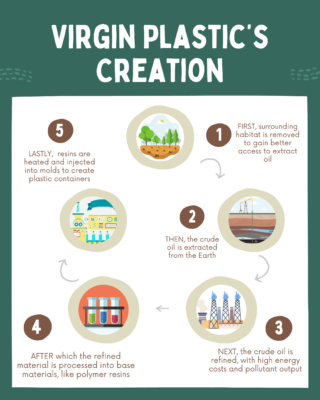
Let's look at Virgin vs Post-Consumer plastics as an example. To produce Virgin Plastic, you first must:
- Remove surrounding habitat near the drill site to gain better access to extract oil.
- Extract crude oil directly from the Earth.
- Refine the oil in a factory. This is very water and energy intensive, and produces pollution and carcinogens as byproducts.
- Use the refined oil to create polymer resins.
- Heat and inject polymer resins into molds to create plastic containers.
To create Post-Consumer plastic bottles, however, you first must:
- Save an existing plastic bottle from landfill and bring it to the WWRA.
- We sort the bottles in our facility and bale them with other bottles.
- We ship these bales to Clean Tech in Dundee, MI to be washed and further separated.
- These bottles are then ground into pellets.
- These pellets are melted and injected into molds to make recycled plastic bottles.
And the process can begin again, closing the loop on a circular economy. At the WWRA, we know which one we would prefer to see on our store shelves!